
This Is Your Brain on Power
Why every good (political) leader may be one shipwreck away from becoming the thing they replaced (6-minute read)

“Power tends to corrupt. Absolute power corrupts absolutely.”
Lord Acton wrote that in 1887. History keeps proving him right.
We assume the corrupted leader had a hidden flaw that finally surfaced. Sometimes that’s true. But the neuroscience points to something we tend to miss: it’s often not character at all. It’s what high status does to a working brain.
I’ve watched the same person become someone else simply by changing roles. That shift doesn’t show up on a personality test. It shows up in how the brain handles power.
So if we want better politics, we can’t just pick better people. We have to build systems that account for what power does to all of them.
I recently re-watched Triangle of Sadness - Ruben Östlund’s Palme d’Or-winning comedy about wealth and survival - and it plays less like allegory than like a case study.
The setup: a luxury yacht of the ultra-rich, waited on by an invisible crew. The yacht sinks. A handful wash up on a desert island, where the only person who can fish, build, or lead is Abigail, the woman who cleaned their toilets. Status flips overnight - and so does she. I’ll use the film throughout, because it shows what research can only name.

Three patterns
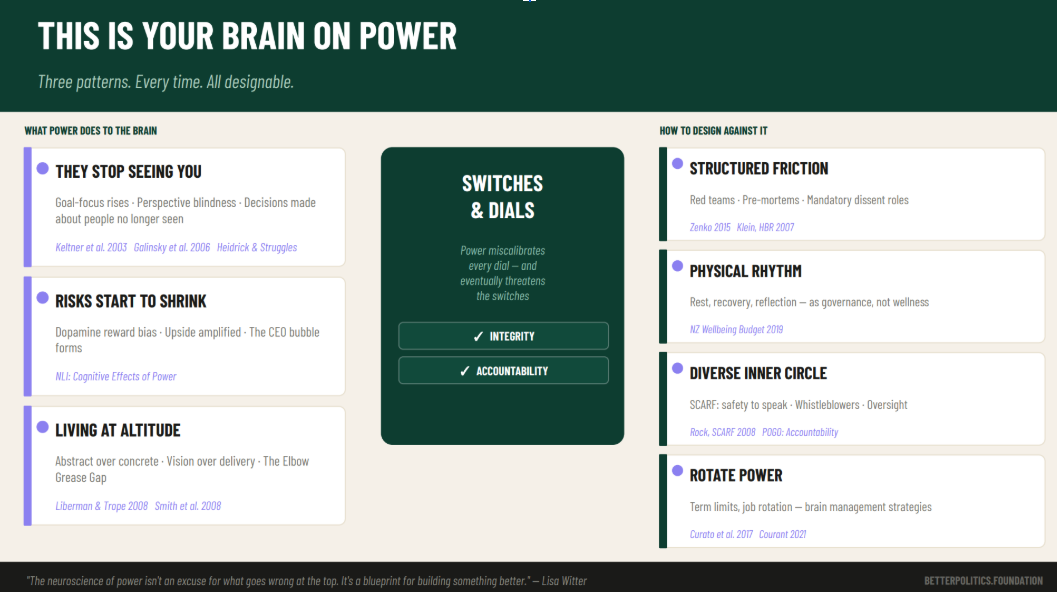
Research on the cognitive effects of power points to three recurring ways power reshapes thinking. They tend to show up regardless of country, background, or character - which is the unsettling part. This isn’t about bad people. It can happen to good ones too.
The fix isn’t just better people. It’s environments that hold these shifts in check.
1. People become harder to see
Power focuses the brain on goals and dampens sensitivity to social cues. Other people start to register as means, not as humans. It isn’t cruelty - they’ve stopped seeing you.
In a now-classic set of experiments, people primed with power were measurably worse at taking another person’s visual perspective and at reading others’ emotions - power seemed to almost instantly impair the ability to appreciate others’ points of view (Galinsky, Magee, Inesi & Gruenfeld, 2006).
On the yacht, the guests can’t see the crew as people - they see them as props. Then the ship sinks, Abigail becomes the island’s only competent survivor, and she runs the exact same filter on her former bosses: withholding food, trading privileges for loyalty. Same mechanism. New hierarchy.
2. Risks look smaller than they are
Power tends to activate the brain’s approach and reward systems. Upside gets amplified; danger gets discounted. Surround a leader with people who only agree, and the bubble seals shut. This approach/reward tilt is the core of Keltner, Gruenfeld and Anderson’s theory of power; elevated power pushes attention toward rewards and away from threat and constraint.
The guests show this before the storm ever hits. Every need anticipated, every discomfort smoothed away - a system built to confirm everything is fine. By the time the danger is real, they’ve lost the instinct to read it. They never had to use it.
3. Living in the clouds
Status pulls thinking toward the big picture and away from how the work actually gets done. Social distance breeds abstraction. Leaders start treating critical feedback as disloyalty - when it’s usually the system trying to stop a bad idea.
The billionaires live in pure abstraction: aesthetics, ideology, self-image. Stranded on a beach, the most “visionary” among them are the most helpless. The one who knows how to fish is the woman who cleaned their toilets.
The courage to slow down and see who isn’t in the room
Early in my career I worked for a politician I admired. The week he won, his base pushed hard for a sweeping housing change. Popular. A clear mandate.
He said no. Not because he disagreed, but because he asked the hard questions: What happens to current renters? Can the schools and roads absorb the growth?
His supporters were furious. He didn’t cave - he laid out the trade-offs and promised to revisit it once protections were in place. Weeks later, his coalition hadn’t broken. It had grown.
Power pulls everyone toward the opposite - toward the room, the base, the people already shouting. He felt that pull too. He just refused to let it decide for him. He saw the people who weren’t in the room. He came down from the clouds to look at the ground.
That isn’t natural. It’s a practice. And we can build environments that make the practice easier.
Switches and Dials
In my “Switches and Dials” framework, some things are switches - always ON. Integrity. Honesty. Flip one off and the leader has failed, whatever the polls say.
Everything else is a dial: speed, risk appetite, vision versus detail. You turn them up or down to fit the moment.
Here’s the twist: power messes with your dials automatically. It turns vision up and empathy down - not by choice, but as output. And if the dials drift far enough, the integrity switch starts to flicker.
Corruption isn’t a moment. It’s a slow drift, one small rationalization at a time.
Triangle of Sadness makes a blunt argument through its plot: “everyone’s equal” is the oldest lie power tells. The film shreds it. Nobody’s switches stay on once the dials drift far enough. Not the guests. Not the captain. Not Abigail.
Character is the switch. The dials are the system. And systems require design, not just good intentions.
What better design looks like
Build in friction. Don’t let everyone agree. Use red teams and pre-mortems - imagine the project has already failed, then work backward. It takes two or three open dissenters to make it safe for everyone else to speak.
Make rest non-negotiable. Exhaustion guts the parts of the brain that handle empathy and risk. This isn’t wellness; it’s governance. New Zealand’s 2019 Wellbeing Budget built long-term wellbeing measures into the actual decision-making.
Protect the critics. People are wired to fear challenging high status. Whistleblower protections and independent oversight are the brakes for when a leader’s brain starts to drift. Nobody could challenge the ship’s captain, who checks out entirely when the crisis hits. Nobody could challenge Abigail. The absence of legitimate dissent made both disasters worse, faster.
Keep people moving. Power effects are tied to the role, not the person. Term limits and rotation aren’t tradition - they stop a brain from getting stuck in high-power mode.
The outsider advantage
Outsiders often read reality more clearly, because they’ve never been rewarded by the bubble. A cross-country study found that greater representation of women in parliament is associated with lower corruption (Dollar, Fisman & Gatti, 2001). But the causation is contested, and the contest is revealing: later researchers argued the link is structural - women rise more easily in open systems that already punish corruption, while entrenched networks of corrupt officials actively suppress outsiders’ access to keep the benefits flowing (Esarey & Schwindt-Bayer, 2018). That’s power doing what power does: protecting itself by deciding who gets into the room.
Abigail captures the double edge. She’s the most competent person in the lifeboat - the only one who can fish, lead, keep people alive. Her years of being ignored gave her a clearer read than anyone. But once she holds power, she starts protecting it: rationing resources, managing threats. Facing the loss of her position, she reaches for a rock. Östlund doesn’t play it as panic. It reads as calculation. And that’s the unsettling part - not that the brain-based account is wrong, but that the two may be the same thing seen from different angles. A brain reshaped by power doesn’t experience itself as distorted. It experiences itself as finally seeing clearly. Power changes what rational feels like from the inside - which is exactly why you can’t expect the powerful to talk themselves out of it.
This is why whistle-blowers matter. They’re a kind of within-outsider - people inside the structure who never fully assimilated to it, and so kept the capacity to see what everyone rewarded by the bubble has stopped noticing. A beneficial fifth column. The same logic runs through the case for a diverse inner circle: the value isn’t representation for its own sake, it’s that someone in the room still has an undistorted read.
Outsiders also pay a tax. The threat of confirming a negative stereotype (Steele, 1997), and the belonging uncertainty that comes with being the only one of your kind in the room (Walton & Cohen, 2011), undermine focus and judgment. If we want diverse leadership to work, we have to support it structurally - not just open the door and walk away.
Diversity isn’t only an equity argument. It’s a cognitive-architecture argument. Different lived experiences mean different ways of seeing, and that recalibrates what power distorts. But only when those leaders are backed, not just invited.
On deliberative democracy
Citizens’ assemblies and participatory budgeting put ordinary people in the room - people whose brains haven’t been marinating in status. In Ireland, a citizens’ assembly helped break years of deadlock on the Eighth Amendment, paving the way to the 2018 referendum. Part of why it worked is that the brains in the room weren’t distorted by power - the social distance that pushes the powerful toward abstraction and away from the concrete (Liberman & Trope, 2008) simply wasn’t operating on them.
The catch: leaders tend to listen only when it suits them - the high-power brain filtering out anything off-plan. So these processes need binding force or real public accountability, otherwise they’re theater.
We also need to train leaders to sit with uncomfortable questions and listen to understand, not just to respond. That’s not a soft skill. It’s brain training. At the Better Politics Foundation, we pull both levers: better systems, and leaders who can manage their own wiring.
The Dark Triad
Everything so far has been about how power changes ordinary brains. But there’s a second mechanism, and it runs the other way. Some people don’t need power to change them - they arrive already tilted, high in Machiavellianism, narcissism, and psychopathy. Those traits can give them an edge on the climb, which means power doesn’t just corrupt good actors; it can hand an advantage to the wrong ones. The instincts that get them to the top are the same ones that ignore the brakes once they’re there.
These are two different problems. The first - power distorting a normal brain - is why you need guardrails for everyone. The second - bad actors self-selecting into power - is why you can’t rely on character screening to catch them, since the traits that win power are the ones that hide best. Good design has to do both jobs at once: restrain the brains that drift, and contain the ones who were already adapted to exploit it - whether that’s a fixed disposition or a habit the climb rewarded.
Designing for balance
These shifts aren’t moral failings. They’re responses to a role. Assign someone power and their thinking tends to change quickly - which tells you exactly where to put the guardrails.
We choose leaders for their past and then forget to build the system that protects their best instincts once they’re in office. Make perspective-taking and accountability structural, and you help leaders stay the people you elected.
That’s not cynicism about leaders. It’s realism about humans.
Triangle of Sadness ends with the rock still raised. We never see what Abigail does. But the point lands anyway: when the system has no brakes, even the people we root for reach for the rock.
Warmly,
Lisa
P.S. Thanks to my colleague Rebekah Ison, our Head of Philanthropy and Insights, whose notes from a recent NeuroLeadership Institute webinar shaped this piece.
A note on the science: these patterns are tendencies measured across groups, not laws that fire identically in every person — and we’re still learning exactly how the brain produces them. Treat this as a useful guide, not a finished map.
Key sources and further reading
Keltner, Gruenfeld & Anderson (2003). Power, approach, and inhibition. Psychological Review, 110(2). https://doi.org/10.1037/0033-295X.110.2.265
Galinsky, Magee, Inesi & Gruenfeld (2006). Power and perspectives not taken. Psychological Science, 17(12). https://doi.org/10.1111/j.1467-9280.2006.01824.x
Dollar, Fisman & Gatti (2001). Are women really the “fairer” sex? Corruption and women in government. Journal of Economic Behavior & Organization, 46(4). https://doi.org/10.1016/S0167-2681(01)00169-X
Esarey & Schwindt-Bayer (2018). Women’s representation, accountability and corruption in democracies. British Journal of Political Science, 48(3).
Swamy, Knack, Lee & Azfar (2001). Gender and corruption. Journal of Development Economics, 64(1).
Steele (1997). A threat in the air: How stereotypes shape intellectual identity and performance. American Psychologist, 52(6). https://doi.org/10.1037/0003-066X.52.6.613
Walton & Cohen (2011). A brief social-belonging intervention improves academic and health outcomes. Science, 331(6023). https://doi.org/10.1126/science.1198364
Liberman & Trope (2008). The psychology of transcending the here and now. Science, 322.
Smith, Jostmann, Galinsky & van Dijk (2008). Lacking power impairs executive functions. Psychological Science, 19(5).
Klein (2007). Performing a project premortem. Harvard Business Review, 85(9).
Zenko (2015). Red Team. Basic Books.
New Zealand Treasury, Wellbeing Budget 2019.
Courant (2021). Citizens’ assemblies for referendums and constitutional reforms. Frontiers in Political Science.
Curato et al. (2017). Twelve key findings in deliberative democracy research. Daedalus, 146(3).
Rock (2008). SCARF: A brain-based model for collaborating with and influencing others. NeuroLeadership Journal, Issue 1.
NeuroLeadership Institute, Cognitive Effects of Power webinar.
Heidrick & Struggles. Wired and unaware: The neuroscience behind leaders’ greatest liability.
Excellent article. Lays out the challenges of democracy for the individual that gains power. And the challenges are many,...outside of the individual changing behavior due to the increased power, there is also the demands of people and agencies invested in you. Individual voters expect action, organizations that donated or supported you expect things, your staff expects things, civil servants and political committees want things,....difficult to balance everything.