
Dalio’s Civility Warning, from the World Governments Summit
Why Civility Is a Powerful Skill for Political Leaders (6 min. read)

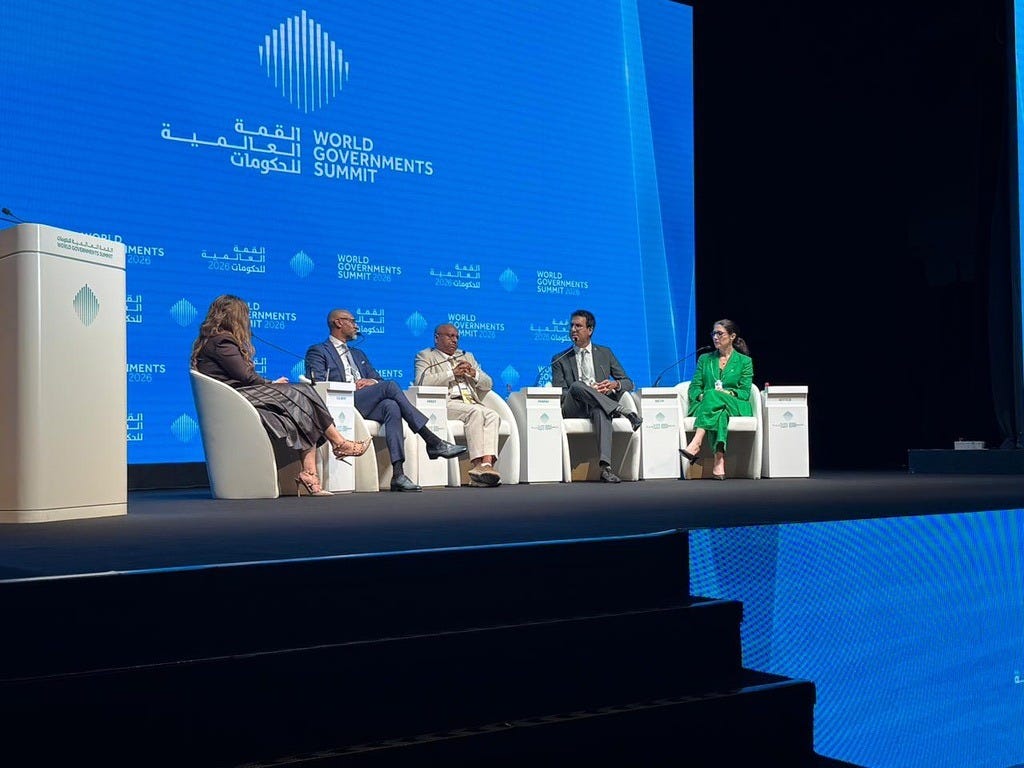
I’ve had the honor of speaking at the World Governments Summit in Dubai for years. Beyond the speakers and the scale, what keeps surprising me is the baseline optimism about the future. That’s not a feeling I get in the West these days.
This Summit is particularly special to me: It recognized the early potential of Apolitical, the company I co-founded with Robyn Scott. This was back when it was just two women, a laptop, and an audacious idea to help make governments smarter. I’m still genuinely grateful for that early belief.
Speakers at the Summit ranged from Spanish Prime Minister Pedro Sánchez to Tesla/SpaceX CEO Elon Musk, to the CEO/Co-Founder of Teach For All Wendy Kopp, to disability advocate Nick Santonastasso, Founder of Victorious International.
Every year, I make sure I’m in the room when Ray Dalio speaks—the insightful American investor and founder of Bridgewater Associates.
Dalio’s “Civil and Productive” Framework
When Ray Dalio spoke about civility, he drew on a central idea in his book, Principles for Dealing with the Changing World Order:
A society needs the ability to be civil to make productivity possible. This pairing is what leads to prosperity.
Productivity creates wealth. But civility is what keeps people from destroying each other while they try to divide that wealth among themselves.
I like this framing because it treats civility as an enabling condition—an operating requirement for prosperity and stability.
Defining “Civility”
Civility has a number of meanings. For political leadership, I think three definitions matter—and they stack.
1) Civility as system integrity (Dalio)
Dalio’s version is broad: civility constitutes a culture of strong character, respect for rules and institutions, low corruption, and the ability to work together cohesively toward shared goals without the system fracturing.
In Principles, this is foundational to his argument: societies rise when they maintain strong character, low corruption, respect for rules, and the capacity to work together productively.
The leadership lesson: Treat the integrity of the system as more important than winning the day.
2) Civility as mutual respect + shared responsibility (civility theory)
Civility theory frames civility as mutual respect grounded in shared responsibility—where opponents are recognized as legitimate co-citizens.
This matters because it makes civility less about “tone” and more about duty. Even in conflict, you’re still co-owners of a shared future.
The leadership lesson: Act like you are going to have to govern together again—because you are.
3) Civility as polite, reasonable behavior (common definition)
The Oxford English Dictionary defines civility as “politeness and courtesy in behavior or speech”.
That can sound small in politics. It isn’t. This definition points to the micro-behaviors that shape the whole environment: tone, turn-taking, whether disagreement becomes humiliation, and whether repair is possible after rupture.
The leadership lesson: The small behaviors become the norms. The norms become the culture. The culture becomes the system that people either trust or abandon. The small moves matter.
The shared core across the definitions
Across these definitions, the overlap is pretty clear: civility is disagreement that does not silence, degrade, or dehumanize alternative views. It is disagreement that signals respect.
The leadership lesson, in plain terms, is: Be ruthless on problems. Be decent with people.
Civility as democratic infrastructure
This is why I’ve appreciated the framing from Jennifer Nadel and Compassion in Politics in the UK. They argue that civility is a first step toward a more tolerant, less toxic political space, and the path to better political decision-making.
Importantly, they treat civility not as ‘vibes’ but as democratic infrastructure, through a practical commitment like the Civility Pledge with the Jo Cox Foundation.
This framing stuck with me because civility isn’t just a moral appeal.
It is a design feature.
Why the “polite, courteous behavior” definition has a brain-based edge
From a brain and behavioral science lens, “polite, courteous behavior” works like a social safety signal. Safety signals change what the brain can do.
When people feel respected rather than humiliated, stress responses are less likely to spike. Under high stress, executive function drops—especially working memory and cognitive flexibility. Those are exactly what leaders and citizens need to weigh trade-offs, hold complexity, and plan beyond the next headline.
Therefore, when public life becomes contempt-heavy, threat responses take over from these executive functions.
Attention narrows.
Rigidity sets in.
Curiosity drops.
People are drawn to simple stories, strong enemies, and absolute certainty.
Humiliation is especially potent because the brain registers social rejection the same way it registers physical pain. It is not abstract - it activates real survival instincts. This drives defense. Defense kills cooperation.
So, incivility doesn’t just “hurt feelings.” It reduces the collective capacity to think and to coordinate.
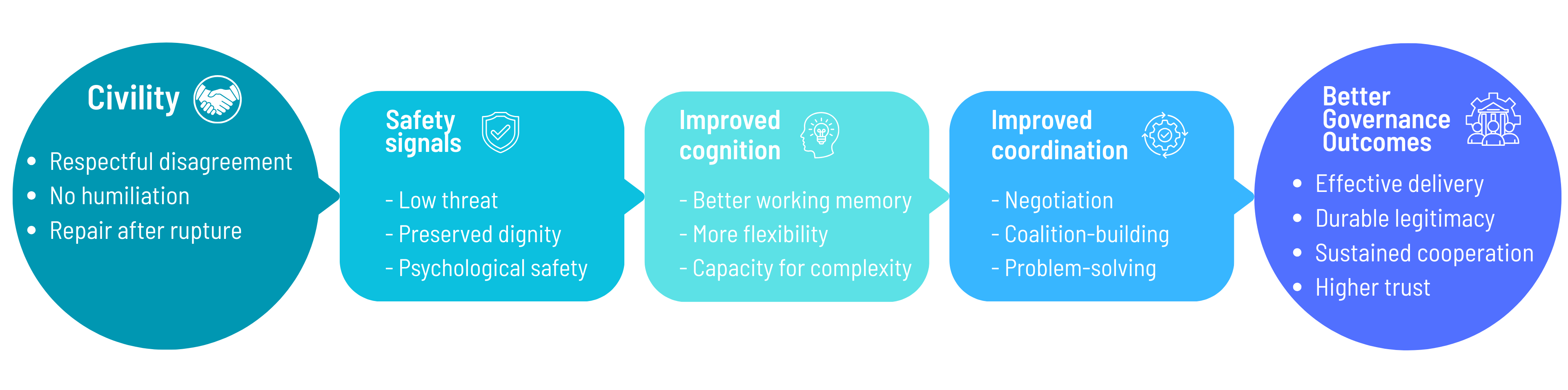
A simple logic model
The behavioral science points to a simple causal chain.
Civility (respectful disagreement, no humiliation, repair after rupture) leads to:
→ Safety signals (low threat, preserved dignity, psychological safety)
→ Improved cognition (better working memory, more flexibility, more capacity for complexity)
→ Improved coordination (negotiation, coalition-building, problem-solving)
= Better governance outcomes (effective delivery, durable legitimacy, sustained cooperation, higher trust)
Incivility (contempt, humiliation, exclusion) leads to:
→ Threat signals (status threat, humiliation risk, defensive arousal)
→ Narrowed cognition (rigidity, certainty-seeking, scapegoats)
→ Coordination failure (breakdowns in negotiation, polarization, zero-sum bargaining)
= Worse governance outcomes (weak delivery, eroded legitimacy, fractured cooperation, declining trust)
Why incivility keeps winning anyway
Incivility can be effective in the short term because:
It grabs attention.
It mobilizes anger.
It sharpens “us vs. them” lines.
It can win the moment.
But it also makes the system harder to run.
What this means for political leadership
If civility is cognitive and democratic infrastructure, leaders have three jobs:
Protect the system (Dalio): defend rules, norms, and institutional integrity.
Practice shared responsibility (civility theory): treat opponents as future partners, not permanent enemies.
Send safety signals (common definition): communicate in ways that keep people regulated enough to reason together.
Civility isn’t weakness. It’s what keeps coordination, productivity, and prosperity possible.
Questions to consider:
Where is civility most structurally undermined in your political environment right now?
And what is one concrete change—in incentives, institutions, or platforms—that would make it easier to practice?
Civilly,
Lisa
P.S. Dalio also has a blunt warning: civility can go too far. If “being civil” turns into avoiding conflict, refusing to draw lines, or letting bad actors break the rules, it becomes weakness—and weakness can lose to “barbarism”. The goal of civility isn’t ‘niceness’. It is strong, enforceable norms that let people disagree and compete without the whole system falling apart.